

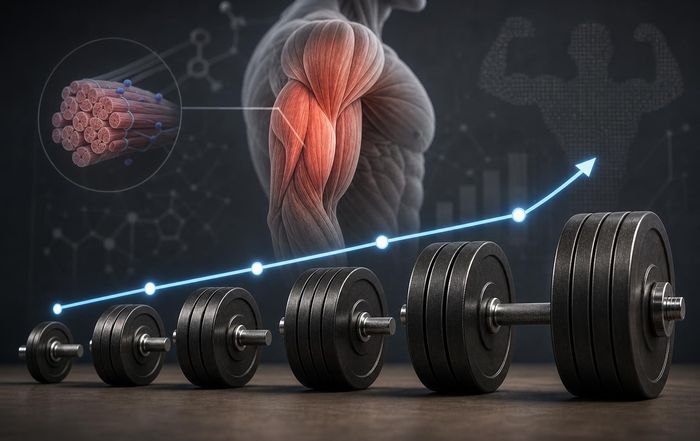
The Science of Progressive Overload for Muscle Growth
Progressive overload is one of the few ideas in strength training that almost every coach, researcher, and athlete agrees on. Whether the goal is building visible muscle, improving strength for sport, or simply staying functional with age, muscles will not grow or get stronger without a gradually increasing challenge. Yet "just lift heavier" is a crude oversimplification of what progressive overload really means and how to apply it safely. This energetic story unpacks the science behind progressive overload, how muscles actually grow, and how to structure training so that overload drives progress rather than burnout or injury.
What progressive overload really means
In exercise science, progressive overload describes the systematic increase in training demand so that the body must adapt beyond its current capacity. The principle dates back to early 20th-century strength research and is a cornerstone in position stands from organizations such as the American College of Sports Medicine (ACSM) and the National Strength and Conditioning Association (NSCA).
At its core, progressive overload means that over weeks and months, some combination of the following must increase:
Load (weight on the bar or machine)
Repetitions per set
Total number of sets
Training frequency (sessions per muscle per week)
Time under tension (tempo and control)
Range of motion or technical difficulty
Density (same work in less time, or more work in the same time)
Importantly, overload is relative to the individual. A 5 kg dumbbell curl might be trivial for a competitive bodybuilder but a significant challenge for a beginner or someone returning after injury. What drives adaptation is not the absolute load, but how much of a challenge it represents for a given person at a given time. Sport fans who want to explore how overload fits into broader training strategies can find more strength-training coverage in our training and physical sections.
How muscles grow: the biology underneath the bar
To understand why progressive overload works, it helps to look at what actually happens inside muscle tissue. When resistance exercise is performed with sufficient effort, it triggers several overlapping mechanisms that researchers such as Brad Schoenfeld and others have highlighted in the scientific literature and in reviews referenced by organizations like the National Institutes of Health.
Mechanical tension
Mechanical tension refers to the force generated by muscle fibers when they contract under load, especially when they are lengthened (eccentric phase) or held under stretch. High levels of mechanical tension activate mechanosensors within the muscle cell membrane and cytoskeleton. These sensors convert mechanical strain into chemical signals, turning on pathways such as mTOR (mechanistic target of rapamycin), which is central to muscle protein synthesis.
Without sufficient tension, muscles receive little signal to grow, regardless of how "tired" a workout feels. This is why some level of load or close-to-failure effort is essential for hypertrophy.
Muscle damage (and why more is not always better)
Resistance training can cause micro-damage to muscle fibers, especially when exercises involve novel movements, long eccentric phases, or unfamiliar loads. This damage is not the same as injury; it is a controlled disruption that, when followed by adequate recovery and nutrition, leads to repair and reinforcement. Satellite cells-muscle stem cells-are activated, fusing with existing fibers and contributing nuclei that help support larger muscle fibers.
However, research summarized by groups such as the International Society of Sports Nutrition suggests that muscle damage is neither required nor directly proportional to growth. Excessive soreness and prolonged performance drops often indicate too much damage relative to recovery, not more effective training. Progressive overload should be gradual, allowing tissues to adapt rather than constantly overwhelming them.
Metabolic stress
Metabolic stress is the "burn" and pump associated with higher-rep sets, shorter rest periods, and sustained muscle contractions. This stress leads to the accumulation of metabolites like lactate, hydrogen ions, and inorganic phosphate, which seem to contribute to hypertrophy indirectly-through cell swelling, hormonal responses, and recruitment of additional motor units.
While mechanical tension remains the primary driver, combining tension with some metabolic stress is effective for muscle growth, especially when total volume is sufficient. This is one reason hypertrophy programs often include a mix of moderate loads (e.g., 6-15 reps) and multiple sets.
For broader context on how these mechanisms interact with recovery, our health and wellness coverage regularly explores sleep, stress, and hormonal factors that influence training adaptations.
The overload equation: volume, intensity, and frequency
In practice, progressive overload is applied through the core training variables of volume, intensity, and frequency. Major sports science bodies, including the World Health Organization and ACSM, provide broad guidelines for resistance training, but the details of overload are where meaningful progress is made.
Training volume
Volume is often defined as the total amount of work performed, commonly measured as sets × reps × load. For hypertrophy, a more practical metric is hard sets per muscle per week, where a hard set is taken close to muscular failure (e.g., within 0-3 reps of failure).
Current evidence suggests that most lifters grow well in a range of roughly 10-20 hard sets per muscle group per week, spread over two or more sessions. Beginners may progress with less; advanced athletes often need more, but with carefully managed recovery.
Progressive overload in volume might mean:
Adding a set to a key exercise over several weeks
Increasing total weekly sets for a muscle group
Expanding from, say, 8 sets per week for chest to 12, then 15, if recovery and performance support it
Training intensity
Intensity in strength training usually refers to the percentage of one-repetition maximum (1RM) or, more practically for many lifters, to reps in reserve (RIR) or rate of perceived exertion (RPE). For hypertrophy, a wide range of loads-from about 30% to 85% of 1RM-can build muscle, provided sets are taken close to failure.
However, moderate loads (roughly 60-80% of 1RM, often 6-15 reps) tend to offer an efficient balance between mechanical tension, volume, and joint stress. Progressive overload in intensity can be as simple as:
Adding weight to the bar when you can perform more reps than your target range
Keeping the same load but reducing RIR (pushing closer to failure) over a mesocycle
Cycling heavier, lower-rep blocks with lighter, higher-rep blocks
Organizations like USA Weightlifting and World Athletics use structured intensity progressions in elite programs, illustrating how planned changes in load are central to long-term development.
Training frequency
Frequency is how often a muscle or movement pattern is trained per week. Research summarized by the NSCA indicates that, when volume is equated, training a muscle twice per week often provides at least as much, and sometimes more, hypertrophy than once per week, likely because it allows higher quality work and more frequent anabolic signaling.
Progressive overload in frequency might involve:
Moving from a single "chest day" to upper/lower splits that hit each muscle twice per week
Shifting from three total-body sessions to four or five, with volume redistributed
Adding a small "top-up" session for lagging muscle groups
Readers interested in how frequency interacts with sports performance can explore more in our sports section.
Forms of progressive overload beyond "add weight"
The simplest model of overload-adding weight whenever possible-is attractive but incomplete. Real-world training uses several overlapping forms of progression, many of which are supported by research from organizations like UK Sport and university strength labs.
Common progression strategies include:
Load progression: Increasing weight when a set rep target is exceeded (e.g., once you can do 3 sets of 10 with 60 kg, move to 62.5 kg and aim for 3 × 8-9).
Repetition progression: Keeping the load constant and gradually adding reps across weeks until the top of a rep range is reached, then increasing load.
Set progression: Adding an extra set to key exercises as long as performance and recovery remain solid.
Density progression: Performing the same volume in less time by slightly shortening rest periods or increasing tempo control, without sacrificing technique.
Range-of-motion progression: Gradually deepening squats, presses, or pulls to increase the effective work of the target muscle, as mobility and stability allow.
Exercise progression: Moving from simpler to more demanding variations (e.g., goblet squat → front squat → back squat) while maintaining or increasing effective volume.
Effective programs usually blend these rather than relying on a single metric. When load stalls, volume or density can still progress; when volume is at its practical limit, load or exercise difficulty can be adjusted.
Programming overload across weeks and months
Progressive overload is not linear forever. Strength and size gains are faster in the first months or years of training and slow as lifters approach their genetic potential. That reality is one reason periodization-planned variation in training variables-is widely used, from recreational lifters to Olympic athletes.
Linear and undulating models
A simple linear progression might increase load session-to-session or week-to-week while keeping reps constant. This works well for beginners because their nervous system and muscles adapt rapidly. Over time, however, fatigue and plateaus make straight-line increases unsustainable.
More advanced programs often use undulating periodization, where reps and loads vary within a week or between weeks. For example:
Day 1: Heavy (4-6 reps, higher load)
Day 2: Moderate (8-10 reps)
Day 3: Lighter or pump-focused (12-15 reps)
This approach exposes muscles to different stimuli-tension, volume, and metabolic stress-while still allowing recovery of specific systems. Research from strength and conditioning groups, including the NSCA, suggests that undulating models are at least as effective as linear ones for hypertrophy and may better support long-term adherence and joint health.
Deloads and managing fatigue
Because overload inherently creates fatigue, well-designed programs include deloads-planned periods of reduced volume and/or intensity, often every 4-8 weeks. Deloads allow accumulated fatigue to dissipate, joint irritation to settle, and motivation to reset, without complete detraining.
A typical deload might reduce volume by 30-50% while keeping some intensity, or maintain volume with significantly lighter loads. Many elite training systems, such as those overseen by national sport institutes and organizations like Australian Institute of Sport, bake deloads into macrocycles to manage athlete health.
Nutrition, recovery, and the overload-adaptation loop
Progressive overload is only half the equation; adaptation happens between sessions. Without adequate nutrition, sleep, and stress management, increased training demand simply accumulates as fatigue.
Protein and total energy
Muscle growth requires a caloric surplus or at least sufficient energy intake to support repair. Most sports nutrition guidelines, including those from the Academy of Nutrition and Dietetics and ISSN, suggest:
Protein: roughly 1.6-2.2 g per kg of body mass per day for people actively pursuing hypertrophy.
Carbohydrates: enough to support training performance, often higher for those doing intense or frequent sessions.
Fats: sufficient for hormonal health, typically not dropping below about 20% of total calories for most individuals.
The exact numbers depend on body size, goals, and overall activity level. Our nutrition coverage dives deeper into evidence-based fueling strategies for training.
Sleep and stress management
Sleep is a powerful anabolic tool. Research from organizations such as the National Sleep Foundation highlights that 7-9 hours of quality sleep per night is associated with better recovery, hormonal balance, and performance. Chronic sleep deprivation blunts muscle protein synthesis, impairs coordination, and increases injury risk.
Psychological stress, whether from work, life, or overtraining, elevates cortisol and can interfere with both performance and adaptation. For many lifters, the smartest form of progressive overload is sometimes doing slightly less in the gym while improving sleep, nutrition, and stress management.
Our wellness and lifestyle sections frequently cover practical approaches to stress reduction, sleep hygiene, and sustainable routines that support training.
Avoiding common overload mistakes
While the principle of progressive overload is simple, its misapplication is one of the main reasons lifters stall or get hurt.
Rushing progression
Beginners often add weight faster than their connective tissues-tendons, ligaments, joint capsules-can adapt. Muscles can feel ready long before joints do. A safer approach is to let technique quality and rep control guide progression, not just the ability to grind out heavier reps.
Chasing soreness as a goal
Delayed onset muscle soreness (DOMS) is not a reliable proxy for muscle growth. Frequently changing exercises, doing extreme eccentric work, or spiking volume can create soreness without better gains. Consistency, gradual increases, and performance trends are better indicators that overload is working.
Ignoring recovery signals
Persistent fatigue, declining performance, poor sleep, irritability, or recurring niggles are signals that overload is outpacing recovery. In these cases, holding volume steady, slightly reducing it, or inserting a deload week can restore progress more effectively than pushing harder.
Neglecting technique under heavier loads
As weights increase, there is a temptation to accept sloppy form to hit numbers. Over time, this shifts stress away from target muscles and toward joints and connective tissues. Using video feedback, coaching, or training partners can help ensure that progressive overload is applied to the muscles, not just the ego.
For readers interested in how these issues intersect with injury prevention and long-term participation in sport and exercise, our fitness and world sections often explore public-health perspectives on activity and musculoskeletal health.
Practical example: applying progressive overload to a basic program
To make the science concrete, consider a lifter training each major muscle group twice per week with a moderate volume routine. For one exercise-the barbell bench press-the overload plan might look like this over several weeks:
Week 1-2: 3 sets of 8 reps at 60 kg, aiming for about 2-3 reps in reserve on the first set.
Week 3-4: Once 3 × 10 at 60 kg is achieved with solid form, increase to 62.5 kg and drop back to 3 × 8, again with 2-3 reps in reserve.
Week 5-6: Add a fourth set if recovery is good, making it 4 × 8 at 62.5 kg.
Week 7: Slight deload-2-3 sets of 6-8 reps at 55-57.5 kg to reduce fatigue.
Week 8-9: Resume at 62.5-65 kg, working back up from 3 × 8 toward 3 × 10.
Across these weeks, volume (sets × reps) and intensity (load) both increase, but in a controlled, stepwise fashion, with a built-in recovery week. Similar logic can be applied to squats, deadlifts, rows, and accessory work-always watching for recovery, performance trends, and technique.
Bringing it together: overload as a long-term habit
Progressive overload is not a single method or a short-term trick. It is an ongoing dialogue between training stress and biological adaptation. For muscle growth, that dialogue is most productive when:
Mechanical tension is high enough to challenge the muscle.
Volume is sufficient but not excessive.
Intensity and frequency are adjusted over time.
Nutrition, sleep, and stress management support recovery.
Increases in training demand are gradual and planned, not random.
The strongest and most muscular athletes rarely reinvent their programs every week. Instead, they repeat key movements, monitor performance, and make small, consistent increases in load, volume, or difficulty over months and years. For anyone aiming to build or maintain muscle-whether in a performance setting or simply to stay healthy and capable with age-treating progressive overload as a patient, structured practice is far more effective than chasing rapid, unsustainable jumps.
For more on how to align progressive overload with different life stages, sports, and health goals, explore our daily news across fitness, training, health, nutrition, and wellness.