

How Denmark's Cycling Culture Powers Everyday Active Living
Denmark is often held up as a place where cycling feels as natural as walking, and where bike lanes seem to outnumber traffic jams. Behind the familiar images of Copenhagen's rush-hour "bicycle highways" lies a deeper story about how infrastructure, policy, culture, and everyday habits combine to support active living at scale. For people interested in fitness and public health, Denmark offers a living case study in what happens when a country quietly reorganizes daily life around human movement instead of car traffic. This article looks at how Denmark built its cycling culture, what it means for physical and mental health, and what lessons other countries-and individual riders-can take from it.
From car country to cycle nation: how Denmark got here
Denmark was not always synonymous with bikes. In the 1950s and 1960s, rising incomes and post-war development led to a rapid growth in car ownership, just as in many other European countries and North America. Cycling declined, and roads in cities like Copenhagen were redesigned to prioritize motor traffic. By the early 1970s, congestion, air pollution, and road deaths-particularly among children-sparked a backlash. Grassroots movements such as the "Stop de Kindermord" (Stop the Child Murder) protests in neighboring Netherlands had parallels in Denmark, where citizens demanded safer streets and better conditions for people walking and cycling.
Crucially, Danish policymakers listened. In response to the oil crises of the 1970s and public pressure, cities began to introduce traffic-calming measures, build separated cycle tracks, and restrict car access in central districts. Copenhagen created its first pedestrian street, Strøget, as early as 1962, but the real acceleration in cycling infrastructure came in the late 1970s and 1980s, when the city committed to a network of protected lanes. Over time, this network expanded and became more coherent, linking residential neighborhoods with schools, workplaces, train stations, and shopping areas.
The result is that cycling is now a mainstream mode of transport, not a niche hobby. According to the City of Copenhagen, more people commute to work or study by bike than by car within the city. Nationally, the Danish Ministry of Transport has reported that a significant share of all trips under 5 km are made by bicycle, reflecting how deeply cycling is embedded in everyday routines. This did not happen overnight; it grew from decades of consistent policy choices, long-term investment, and a cultural shift that normalised the bicycle as a practical tool rather than a symbol of sport or status.
Infrastructure that makes movement the default
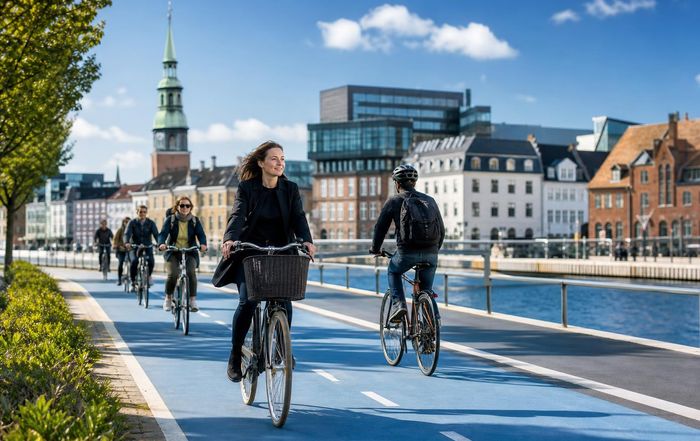
At the heart of Denmark's active living model is infrastructure that makes cycling feel easy, safe, and predictable. Unlike many places where cyclists must share narrow lanes with fast-moving traffic, Danish cities typically separate bikes from cars with dedicated tracks, clear road markings, and traffic lights designed for two wheels.
In Copenhagen and surrounding municipalities, a network of so-called "Cycle Superhighways" connects suburbs to the city centre. These routes prioritise directness and comfort: smooth surfaces, gentle curves, limited stops, good lighting, and winter maintenance. For many commuters, these paths are the equivalent of expressways for bikes, turning a 10-20 km trip into a realistic daily ride rather than a special fitness challenge. This kind of design aligns with the World Health Organization's recommendation that urban planning should support active transport as a core public health strategy, not an afterthought.
Crucially, infrastructure does not stop at the city boundary. Smaller Danish towns and rural areas often have cycle paths linking villages, schools, and train stations, reflecting a national approach rather than a single-city experiment. The Danish Road Directorate and local municipalities coordinate standards, signage, and safety measures, helping to create a consistent experience across regions. When people know what to expect on the road-predictable intersections, clear priority rules, and visible bike lanes-they are more likely to choose cycling without needing to think of themselves as "cyclists" in a lifestyle sense.
For those interested in structured training as well as commuting, this infrastructure also doubles as a convenient way to build everyday cardio. Long, uninterrupted stretches of path allow riders to maintain steady effort, while quieter country roads and coastal routes cater to more sport-oriented cycling. The boundary between transport and training blurs, which is one of the quiet strengths of the Danish model for active living.
If you're curious how infrastructure shapes movement patterns more broadly, similar themes appear in coverage of urban fitness and training and how cities influence everyday activity choices.
Cycling as daily exercise: health benefits in real life
From a fitness perspective, Denmark's cycling culture is essentially a population-wide exercise program disguised as transport. Moderate-intensity cycling-like the kind involved in commuting or errands-fits squarely within the World Health Organization's guidelines of at least 150-300 minutes of moderate aerobic activity per week for adults. Because many Danes ride several short trips a day, they often meet or exceed these recommendations without setting foot in a gym.
Research cited by organizations such as the European Cyclists' Federation and Cycling UK suggests that regular cycling can reduce the risk of cardiovascular disease, type 2 diabetes, and some cancers, while improving cardiorespiratory fitness and body composition. A large cohort study from the University of Copenhagen has found associations between active commuting and lower all-cause mortality, even after adjusting for other factors like leisure-time physical activity. While such studies cannot prove causation in every detail, they consistently point in the same direction: integrating cycling into daily routines is strongly linked to better health outcomes.
On an individual level, this plays out in simple ways. A 15-20 minute ride to work twice a day adds up to 150-200 minutes of moderate activity across the workweek, before counting weekend rides, errands, or social trips. Children who cycle to school accumulate daily movement that supports healthy growth, bone strength, and motor skills, aligning with guidelines from bodies like the American College of Sports Medicine and NHS in the UK. For older adults, cycling provides low-impact joint-friendly exercise that can help maintain muscle mass and balance, reducing fall risk.
The key is that in Denmark, this activity is mostly incidental. People ride because it's convenient, fast, and affordable, not because they are consciously "working out." For fitness enthusiasts, that raises an important question: how can more of one's own daily travel be converted into exercise, in the same way Danes routinely do?
Readers looking to complement active commuting with structured workouts may find it useful to combine cycling with strength sessions and mobility work, topics explored in more depth in our broader fitness and physical training coverage.
Mental wellbeing, stress relief, and the rhythm of the ride
The benefits of Denmark's cycling culture are not purely physical. There is growing evidence that active transport supports mental health, and Danish riders experience this daily. Studies referenced by organizations such as Mental Health Foundation and the American Psychological Association highlight how regular physical activity reduces symptoms of anxiety and depression, improves sleep quality, and supports cognitive function. Cycling in particular combines rhythmic movement, outdoor exposure, and a sense of autonomy-all factors associated with better mood and lower stress.
In Danish cities, the commute by bike often replaces time spent sitting in traffic or on crowded public transport. The act of pedalling through fresh air, even in winter, gives a built-in decompression period at the start and end of the workday. For many riders, this becomes a ritual that separates work from home life, which psychologists identify as important for recovery and work-life balance. The social dimension matters as well: bike lanes are busy, but the pace is human, and riders frequently encounter neighbors, colleagues, or classmates on the same routes.
There is also a cultural normalisation of being outdoors in varied weather, supported by the Danish concept of friluftsliv (open-air life) and the broader Nordic idea that "there's no bad weather, only bad clothing." This mindset encourages people to ride year-round, which in turn maintains consistent activity levels and daylight exposure, both of which can help counter seasonal dips in mood. Public health agencies such as Sundhedsstyrelsen (the Danish Health Authority) and international bodies like the WHO have increasingly highlighted the mental health co-benefits of active lifestyles, reinforcing the value of policies that make everyday exercise easy.
For readers interested in the mental side of active living, Denmark's example dovetails with broader themes in wellness and health, where movement, environment, and social norms interact to shape how people feel, not just how fit they are.
Culture, policy, and social norms: why Danes actually ride
Infrastructure alone does not guarantee that people will cycle. Denmark's success also rests on cultural norms, policy choices, and a legal framework that collectively make cycling the default for short and medium trips.
One important factor is that cycling is socially neutral. In many countries, bikes are associated either with competitive sport or with people who cannot afford cars. In Denmark, politicians in suits, students in jeans, and parents carrying children all use bikes. There is no special outfit required; everyday clothes are the norm. This reduces psychological barriers and helps people see cycling as simply another way to get around. Media campaigns from organizations like the Danish Cyclists' Federation reinforce a positive, inclusive image of cycling while providing practical safety guidance.
Policy also nudges behaviour. Parking for bicycles is abundant and often located closer to building entrances than car parking. In central Copenhagen, car parking is limited and expensive, and speed limits are lower on many streets. Combined with congestion charges or traffic-calming measures in some areas, this makes driving less attractive for short trips. On the other hand, bikes can usually be parked for free, and many trains and metro lines are designed to accommodate bicycles, supporting multimodal travel. National taxation policy has historically favored cycling through measures like tax-free employer-provided bikes or mileage allowances for bike commuting, although specific schemes evolve over time.
Education plays a role, too. Danish children typically receive traffic and cycling education in school, sometimes including supervised on-road training and a "cycling test" in later primary grades. This builds skills and confidence early, while also shaping attitudes among drivers, who are often cyclists themselves and therefore more accustomed to sharing the road. Road rules and liability frameworks, influenced by EU norms and national law, generally place a strong duty of care on drivers toward more vulnerable road users, reinforcing a safety culture that supports active transport.
These elements intersect with broader Danish priorities around sustainability and livable cities, topics that also surface in international coverage from organizations like the OECD and UN Environment Programme. Cycling is framed as part of a coherent package: cleaner air, quieter streets, lower emissions, and healthier citizens, rather than a single-issue campaign.
How Denmark's model compares internationally
For readers outside Scandinavia, it can be tempting to dismiss Denmark as an outlier whose success cannot be replicated. Climate, urban form, and political culture do matter, but international comparisons show that many aspects of the Danish approach are transferable when adapted to local conditions.
Countries such as the Netherlands, Germany, and, increasingly, cities in the UK, United States, and France have drawn lessons from Danish and Dutch practice. Organizations like C40 Cities and ICLEI have highlighted Copenhagen's cycling strategies in their climate and health case studies, emphasizing that the key ingredients are political will, consistent investment, and integrated planning rather than any single spectacular project. Separated cycle lanes, lower speed limits, safe junction design, and secure bike parking are all being deployed in cities from Paris to New York, often with rapid increases in cycling volumes and active commuting.
However, Denmark's long-term consistency remains distinctive. Rather than building a few flagship routes and stopping, Danish cities have spent decades filling gaps, improving junctions, and upgrading older infrastructure to modern standards. They have also aligned transport planning with housing, schools, and workplaces, reducing travel distances and making cycling competitive with driving in terms of time and convenience.
For fitness-focused readers, the key takeaway is that environments matter. It is easier to maintain an active lifestyle when cities and towns make movement safe, direct, and socially accepted. That insight supports not only personal choices but also advocacy for better infrastructure, which can amplify individual efforts by making healthy options easier for everyone.
For more on how broader systems-from workplaces to city plans-shape physical activity, see our wider coverage of sports, lifestyle, and world health trends.
Practical lessons for individuals and other cities
While no place can simply copy-and-paste Denmark's cycling culture, there are concrete lessons that cities, workplaces, and individuals can adapt.
For city planners and policymakers, Denmark underscores the value of designing networks, not isolated segments. Protected lanes that connect residential areas to schools, employment centers, and transit hubs are far more effective than short, disconnected stretches. Integrating cycling with public transport-through bike parking at stations, bike-friendly trains, and coherent ticketing policies-extends the reach of active travel. International guidelines from bodies like the World Bank and UN-Habitat increasingly echo these principles, drawing on Nordic examples among others.
Workplaces can also take cues from Danish employers, many of whom provide secure bike parking, showers, changing facilities, and sometimes financial incentives for bike commuting. These relatively modest investments can significantly increase the share of employees who feel comfortable cycling, particularly for those who combine their commute with more intense training rides. Aligning such measures with corporate wellness programs or health insurance incentives can amplify their impact.
For individuals in less bike-friendly environments, Denmark's example still offers useful strategies. Starting with short, manageable trips-such as rides to the gym, grocery store, or a nearby park-can help integrate cycling into weekly routines. Choosing routes with lower traffic, even if slightly longer, can make rides feel safer and more enjoyable. As comfort grows, using a bike for regular commutes or errands can turn otherwise sedentary time into reliable cardio. Combining cycling with strength and mobility work, as explored in our training and nutrition sections, can create a balanced, sustainable fitness approach.
Community-level efforts-such as local bike advocacy groups, "bike bus" rides for children going to school, or open-streets events-mirror some aspects of Danish culture-building. They help normalise cycling, create social support, and give residents a glimpse of what streets could feel like with more active transport. International organizations, including Global Designing Cities Initiative and Sustrans, offer toolkits and examples that draw on experiences from Denmark and other cycling-forward countries.
Why Denmark's cycling story matters for active living
Denmark's cycling culture is not simply about bikes; it is about designing daily life so that physical activity becomes the path of least resistance. Through decades of infrastructure investment, supportive policies, and social norms that treat cycling as an ordinary, respectable way to travel, Denmark has embedded movement into the fabric of everyday routines. The result is a population that collectively accumulates large amounts of moderate exercise, with clear implications for cardiovascular health, metabolic risk, mental wellbeing, and environmental quality.
For fitness-minded readers, the Danish example highlights an important shift in thinking: instead of viewing exercise solely as something that happens in a gym or on a sports field, it can be woven into commuting, errands, and social activities. Even if your city is far from Copenhagen in terms of infrastructure, adopting elements of this mindset-choosing active transport where possible, advocating for safer streets, and treating movement as a default rather than a special event-can bring some of the same benefits on a personal scale.
As more countries grapple with rising rates of inactivity, chronic disease, and climate stress, Denmark's quiet, everyday cycling revolution offers a powerful reminder: sometimes, the most effective health intervention is as simple as making it easy, safe, and normal to ride a bike.