

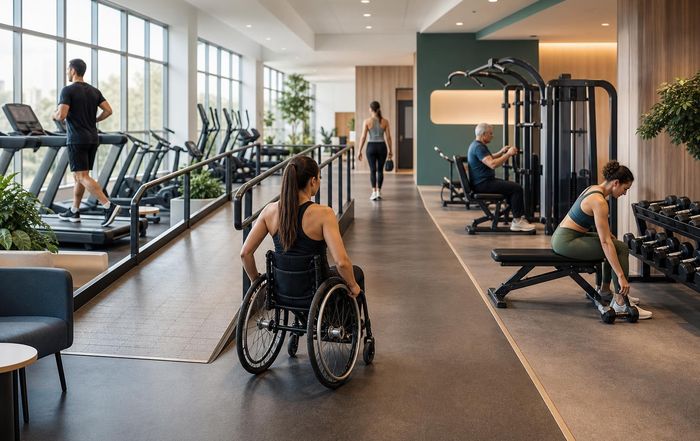
The Business Case for Accessible Gym Design
Fitness is often marketed as "for everyone," yet many gyms are still difficult or impossible to use for people with disabilities, older adults, and anyone with temporary mobility limitations. That gap is not just a social or ethical issue; it is a missed commercial opportunity. As populations age, awareness of disability rights grows, and regulators tighten expectations around accessibility, the business case for accessible gym design is becoming more compelling for operators, investors, and brands.
This feature thinks about at why accessibility is now a strategic business issue in the fitness industry, what it practically involves, and how gyms can implement inclusive design in ways that are both commercially smart and operationally realistic.
Why accessibility is now a core business issue, not a "nice-to-have"
From a purely commercial perspective, accessible design expands the addressable market. The World Health Organization estimates that over 1 billion people-around 16% of the global population-live with some form of disability, a figure that is expected to rise as populations age worldwide. Many of these individuals want to be physically active, and research consistently shows that people with disabilities are more likely to be physically inactive than those without, often due to environmental and attitudinal barriers rather than lack of interest. This represents a large, underserved segment for gyms, studios, and health clubs that can demonstrate they are genuinely welcoming and usable.
In markets like the United States, the Americans with Disabilities Act (ADA) has long required accessible public accommodations, including fitness facilities. Similar legislation exists in the UK, EU, Canada, Australia, and many other regions, with regulators and courts increasingly interpreting "access" in a broad and practical way: it is not enough to have a ramp at the door if the locker rooms, equipment layout, or digital booking systems are unusable. Non-compliance can bring legal costs, fines, and reputational damage, but the more important business story is that accessible gyms can attract new members, retain aging clients, and position themselves as trusted community health partners.
Accessibility also strengthens brand equity. For fitness brands competing in crowded markets, inclusive design can differentiate their offering, drive word-of-mouth, and support partnerships with healthcare providers, insurers, and community organizations. For readers interested in broader wellness trends, accessible design aligns closely with the shift toward holistic health, preventive care, and social prescribing, where clinicians recommend physical activity as part of treatment plans and look for facilities that can safely accommodate diverse needs.
The market opportunity: disability, aging, and inclusive fitness
Demographic and health trends are reshaping the potential customer base for accessible gyms. Global organizations like the United Nations and World Bank have highlighted disability inclusion as a development priority, emphasizing that people with disabilities face higher rates of poverty and poorer health outcomes, in part due to barriers to services-including exercise facilities. Meanwhile, the Centers for Disease Control and Prevention (CDC) notes that in the U.S., 6 in 10 adults have at least one chronic disease, and many conditions such as arthritis, cardiovascular disease, and diabetes benefit from supervised, accessible physical activity.
At the same time, populations in Europe, North America, and parts of Asia-Pacific are aging rapidly. Older adults are one of the fastest-growing potential membership segments for gyms and wellness clubs, but they often require features like step-free access, handrails, good lighting, clear signage, and equipment that is easy to get on and off. These are many of the same features that support people with long-term disabilities, temporary injuries, pregnant people, and anyone with reduced mobility. Designing for one group often benefits many others-an effect sometimes called the "curb cut" effect, after the way wheelchair curb ramps also help people with strollers, luggage, or bikes.
From a business standpoint, this convergence of disability and aging trends means that accessible design is not about serving a small niche; it is about preparing for the mainstream membership profile of the next 10-20 years. Operators that invest now can build loyalty among current members and become the default choice for older adults and people referred from healthcare services. Those that do not may find themselves losing members as they age or face pressure from more inclusive competitors.
For gym operators exploring how to align with broader health and wellness, resources such as WHO's physical activity guidelines and national health bodies like NHS in the UK or the National Institutes of Health (NIH) in the U.S. provide evidence on the benefits of exercise for people with chronic conditions and disabilities. That evidence can strengthen the case for partnerships with healthcare professionals and insurers, especially when a facility can demonstrate high accessibility standards.
Legal and regulatory risk: compliance as a baseline, not the goal
Legal compliance is often the starting point for conversations about accessibility, but it should not be the endpoint. In the U.S., the ADA and related regulations require public accommodations, including gyms, to remove barriers where it is "readily achievable" to do so. Case law has increasingly clarified that this extends beyond just structural elements to include policies, staff training, and in many situations, digital services like websites and apps. In Europe, the European Accessibility Act and national equality laws impose similar obligations, while countries such as Canada and Australia have their own disability discrimination and accessibility frameworks.
For fitness operators, the immediate business implications of non-compliance can include lawsuits, settlement costs, mandatory remediation, and negative media coverage. High-profile disability discrimination cases in other sectors-such as retail, hospitality, and digital services-have shown how quickly public perception can shift when an organization is seen as excluding disabled people. Even when legal action is avoided, failing to accommodate reasonable requests (such as a member needing assistance with equipment adjustments or requesting accessible changing facilities) can generate complaints, bad reviews, and local reputational damage that is hard to repair.
However, regulations typically define minimum standards, not best practice. Meeting only the legal baseline may still leave a facility functionally inaccessible in practice-for example, by providing a technically compliant ramp that is steeper than most wheelchair users can manage independently, or by having a single accessible changing room that is frequently used as storage. From a business perspective, this is short-sighted: a gym that goes beyond compliance to offer genuinely usable, dignified access is more likely to attract loyal members, positive media coverage, and partnerships with organizations that care about inclusion.
Operators looking for guidance can refer to resources from national accessibility bodies and standards organizations such as ISO, which has developed international standards related to accessibility and ergonomics, or national building codes and design guides. Industry associations and disability advocacy groups in many countries also publish practical checklists and case studies that help translate legal requirements into everyday design decisions.
Revenue, retention, and brand loyalty: how accessibility pays off
The most direct financial benefit of accessible gym design is increased membership potential. When a facility is visibly and functionally accessible, it becomes a viable option for people who might previously have dismissed gyms as unsafe or unwelcoming. This can include wheelchair users, people with visual or hearing impairments, neurodivergent individuals, older adults, people recovering from surgery, and parents with strollers. Many of these members may be willing to travel further or pay a premium for a gym that they can use independently and comfortably.
Retention is another major factor. Acquiring new members is typically more expensive than keeping existing ones, and one of the most common reasons people cancel memberships is a change in health status: injury, pregnancy, illness, or simply getting older. An accessible gym can adapt with its members over time, offering modified programs, accessible equipment, and supportive staff that help people stay active through life transitions rather than dropping out. This continuity can translate into years of additional membership revenue per person.
Accessibility also strengthens brand loyalty and word-of-mouth marketing. When members with disabilities or older adults feel genuinely welcomed, they often become vocal advocates, recommending the facility to peers, family members, healthcare providers, and online communities. In an era when online reviews and social media significantly influence consumer choices, stories about positive, inclusive experiences can be powerful. Conversely, a single negative experience-such as a member being unable to access a class due to a step or being refused reasonable assistance-can quickly spread and deter prospective members.
For gyms that offer corporate memberships or partner with employers, accessibility can be a selling point in tenders and contracts. Many large companies now have diversity, equity, and inclusion (DEI) targets and are under pressure to ensure that employee benefits, including fitness perks, are accessible to staff with disabilities. Being able to demonstrate accessible design, staff training, and inclusive programming can help a gym win or retain corporate clients. Similarly, insurers and health systems increasingly look for facilities that can safely serve people with chronic conditions, making accessibility a prerequisite for referral pathways.
What accessible gym design actually looks like in practice
Accessible design is often misunderstood as simply installing a ramp or a lift. In reality, it is a holistic approach that considers the entire member journey-from researching the gym online and contacting staff, to entering the building, using facilities, participating in activities, and leaving safely. It also considers different types of disability: physical, sensory, cognitive, and mental health-related. While specific standards vary by country, a number of common design and operational elements tend to appear in best-practice facilities.
At the building level, step-free access at the main entrance, accessible parking spaces close to the door, automatic or easy-to-open doors, and clear, well-lit routes are central. Inside, circulation spaces need to be wide enough for wheelchair users to move comfortably, including around equipment and through corridors. Elevators, where needed, should be large enough to accommodate wheelchairs and have controls at reachable heights, with tactile and visual indicators. Flooring should be non-slip and level, and lighting should minimize glare while providing sufficient illumination, especially on stairs and in changing areas.
In the locker rooms and wet areas, accessible design might include private changing cubicles with space for a wheelchair and a companion, benches at appropriate heights, grab rails, roll-in showers with seats, and accessible toilets that meet or exceed national standards. Pool areas may feature sloped entries, pool lifts, or transfer systems. In group exercise studios, ample space should be provided near entrances and exits for wheelchair users or those who prefer to sit, with clear sightlines to instructors.
From an equipment perspective, accessible gyms often combine standard machines with specialized or carefully chosen models. This can include cardio equipment with step-through frames, low step heights, or removable seats; resistance machines that can be used from a seated position or wheelchair; and free weight areas with adjustable benches and adequate space between racks. Manufacturers such as Life Fitness, Technogym, and Matrix have introduced equipment ranges that consider accessibility features, though availability and specific models vary by market. Thoughtful layout-such as grouping accessible equipment together without segregating users, and ensuring clear turning circles-is just as important as the machines themselves.
For gym operators planning or upgrading training spaces, exploring how accessible design intersects with strength and conditioning can be useful. Internal resources like the site's own training section and physical fitness coverage can help connect design decisions to actual workout practices and programming.
Digital, sensory, and communication accessibility
Modern gym experiences are not limited to the physical environment. Websites, apps, online booking systems, and digital content are now central to how members discover, join, and use facilities. If these digital touchpoints are not accessible, many potential members will never make it to the front door. International guidelines such as the Web Content Accessibility Guidelines (WCAG), maintained by the World Wide Web Consortium (W3C), provide a widely recognized framework for digital accessibility, covering areas like screen reader compatibility, color contrast, keyboard navigation, and captions for video content.
For a gym, practical digital accessibility might include an accessible website that clearly describes facilities (including specific accessibility features), online forms that can be completed with assistive technologies, and apps that do not rely solely on color or complex gestures. Providing text alternatives for images, transcripts or captions for video classes, and simple, plain-language explanations of membership options can help a wide range of users, including people with cognitive disabilities or limited language proficiency. An accessible digital presence also supports remote or hybrid fitness programs, which can be critical for members who cannot always attend in person.
Sensory and communication accessibility within the facility are just as important. Background music at very high volumes, flashing lights in some studio classes, and constant loud announcements can be overwhelming or even unsafe for people with sensory sensitivities, autism, or certain neurological conditions. Offering quieter zones, clearly communicating when high-stimulation classes are scheduled, and providing alternative spaces can make a big difference. Clear, high-contrast signage with pictograms helps people with visual impairments or limited literacy, while induction loops or other assistive listening systems can support members with hearing aids in reception areas or studios.
Staff communication is another key element. Training front-of-house staff, instructors, and personal trainers to communicate clearly, ask members how they prefer to be assisted, and understand basic disability etiquette can transform the experience. For example, staff should know not to move a wheelchair without asking, how to describe equipment layout verbally for someone with low vision, and how to adapt exercise instructions for different abilities. These skills complement broader wellness and health knowledge and can be integrated into ongoing professional development.
Cost, ROI, and practical implementation strategies
One of the most common concerns among gym owners is cost: will accessible design be prohibitively expensive, especially for smaller independent facilities? In practice, many of the most impactful changes are relatively low-cost when incorporated early in design or refurbishment, and even retrofits can often be staged over time. The business case rests on understanding both direct and indirect returns.
Direct returns include new memberships from people who previously could not use the facility, improved retention among aging or injured members, and potential new revenue streams from specialist classes, rehabilitation programs, or partnerships with healthcare providers. Indirect returns include reduced legal risk, stronger brand reputation, better staff morale, and alignment with ESG (environmental, social, and governance) priorities that matter to investors and corporate partners. For example, major asset managers and initiatives like the Global Reporting Initiative (GRI) encourage companies to report on social inclusion, and accessible facilities can form part of that narrative.
From a cost-management perspective, gyms can start with an accessibility audit-either self-assessed using checklists from disability organizations or conducted by specialist consultants. This helps identify "quick wins" such as rearranging equipment to improve circulation, adding grab rails, improving signage, or adjusting lighting. More capital-intensive changes, such as installing lifts or reconfiguring locker rooms, can be planned into future refurbishment cycles or financed as part of broader modernization projects.
It is also worth recognizing that many accessibility improvements benefit operational efficiency and member satisfaction more broadly. For instance, clear wayfinding reduces staff time spent giving directions, better lighting improves safety and reduces incidents, and flexible equipment layouts can make it easier to adapt spaces for different classes or events. For gyms with a strong focus on lifestyle and wellness, accessible design can integrate seamlessly into a broader "member experience" strategy rather than being treated as a separate, compliance-only project.
Programming, culture, and staff: beyond the physical design
Even the best-designed accessible facility will underperform if programming and culture do not support inclusion. Classes that assume full mobility, instructors who are unsure how to offer modifications, or policies that inadvertently exclude support workers or carers can all undermine the value of physical investments. To unlock the full business benefit of accessibility, gyms need to integrate inclusion into programming, staffing, and community-building.
On the programming side, this can mean offering classes explicitly marketed as inclusive or adaptive, such as seated strength training, low-impact cardio, or balance and fall-prevention classes for older adults. It can also mean ensuring that mainstream classes include clear options for different ability levels, with instructors trained to demonstrate variations and to normalize the use of props, chairs, or alternative movements. Partnerships with physiotherapists, occupational therapists, or clinical exercise professionals can help design safe, evidence-based programs for people with specific conditions.
Staff culture is equally important. Recruitment and training processes can emphasize inclusive communication, awareness of different disabilities, and confidence in adapting exercises. Bringing in external trainers from disability organizations, or collaborating with national bodies like Special Olympics or Paralympic committees where appropriate, can deepen staff understanding and create new program ideas. Encouraging staff to see accessibility as part of professional excellence, not an add-on, helps embed it into daily operations.
Policies and pricing models may also need review. For example, allowing personal assistants or carers to accompany a member at no or reduced additional cost can be essential for some people to attend. Clear, flexible cancellation policies can support members whose health conditions fluctuate. Transparent information about accessible features, available on the gym's website and marketing materials, helps set expectations and reduces the emotional labor for potential members who might otherwise feel they must "ask permission" to attend.
For readers interested in how these cultural elements intersect with broader wellness and nutrition strategies, it is useful to see accessible design as part of a holistic approach: creating environments where diverse bodies and abilities are recognized, supported, and celebrated rather than treated as exceptions.
Positioning accessible gyms within the wider fitness and wellness landscape
The shift toward accessible gym design is part of a broader evolution in the fitness industry, where health, technology, and culture increasingly intersect. Digital fitness platforms, wearable devices, and telehealth services from companies like Apple, Google, and Samsung have expanded how and where people move, but they have also highlighted the ongoing importance of physical spaces that are inclusive and community-oriented. As more health systems and insurers promote exercise as medicine, gyms that can demonstrate accessibility, safety, and evidence-based programming are better positioned to participate in integrated care pathways.
At the same time, media coverage from outlets such as BBC, The New York Times, and The Guardian has given more visibility to disability rights and inclusion in sport and physical activity. International sporting events like the Paralympic Games, governed by the International Paralympic Committee (IPC), showcase elite performance by athletes with disabilities and shift public perceptions about what is possible. Grassroots and community-level inclusion, however, still depends heavily on local facilities and programs. Gyms that align themselves with this broader movement can strengthen their reputation not only as businesses but as community health assets.
From a strategic perspective, accessible design can also open up new partnerships across business, brands, and events. Inclusive facilities are better placed to host adaptive sports events, inclusive fitness expos, or corporate wellness days that must accommodate diverse participants. Brands in sportswear, assistive technology, or health tech may seek collaborations with gyms that can credibly demonstrate accessibility, creating sponsorship or co-marketing opportunities.
Ultimately, accessible gym design is about aligning commercial success with social value. In a sector where differentiation is increasingly hard to achieve through equipment or aesthetics alone, a credible commitment to inclusion can be a powerful driver of trust, loyalty, and long-term growth. For operators willing to see accessibility not as a cost center but as a strategic investment, the business case is strong-and likely to grow stronger as expectations from members, regulators, and partners continue to rise.
For those exploring how to integrate accessibility into broader fitness strategies, the site's core fitness coverage, wellness insights, and technology section offer additional angles on how design, programming, and digital tools can work together to make movement truly available to everyone.