

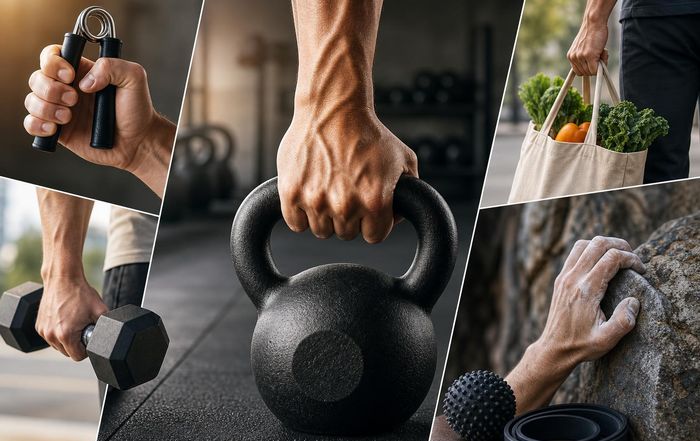
How to Improve Grip Strength for Everyday Fitness
Strong hands are easy to overlook until a jar will not open, shopping bags cut into your fingers, or your forearms give out before your legs during a workout. Grip strength is more than a "nice to have" for athletes; it is a practical marker of overall health, independence, and performance in everyday life.
This fit guide explains what grip strength is, why it matters for daily function and long-term health, and how to build it safely and effectively-whether you train in a gym, at home, or simply by tweaking daily habits.
Why Grip Strength Matters Beyond the Gym
Grip strength is typically measured by how hard you can squeeze with your hand, often using a dynamometer in research and clinical settings. It reflects the combined strength of the muscles in your hands, wrists, and forearms, and it is closely tied to how well you can manipulate and hold objects.
Large population studies summarized by organizations such as the World Health Organization and research groups referenced by the National Institutes of Health have found that lower grip strength is associated with higher risk of mobility limitations, disability, and even all-cause mortality in older adults. While grip strength itself is not a magic health test, it often acts as a proxy for overall muscle function and physical reserve.
In everyday life, better grip strength supports a surprising range of tasks: carrying groceries, lifting luggage into overhead bins, holding onto bus or subway rails, opening doors, using tools, gardening, and safely catching yourself during a stumble. In the gym, grip can be the limiting factor in deadlifts, pull-ups, kettlebell swings, and rowing work. Improving grip strength can therefore translate into better progress in many compound exercises covered in general strength guides and training sections such as fitness, training, and physical conditioning.
For people who work at a desk, use a mouse all day, or spend long hours on a phone, targeted grip and forearm work can also help counter some of the muscular imbalances and fatigue that contribute to discomfort in the hands and wrists. While strengthening alone does not treat medical conditions like carpal tunnel syndrome, it can be part of a broader ergonomic and movement strategy discussed in many health and wellness resources.
The Different Types of Grip You Actually Use
Improving "grip strength" is easier when you understand that grip is not a single quality. Coaches and strength organizations such as the National Strength and Conditioning Association often break grip into several types, each of which shows up in daily life:
Crushing grip is the force you use when squeezing something in your palm, like a hand gripper, a stress ball, or someone's hand in a handshake. This is the type most people think of when they imagine grip strength, and it relies heavily on the finger flexors and the muscles of the palm and forearm.
Support grip refers to your ability to hold onto something for time, such as hanging from a pull-up bar, carrying heavy shopping bags, or holding dumbbells during a farmer's carry. This kind of endurance-oriented grip is critical for both gym performance and everyday tasks that last more than a few seconds.
Pinch grip is the strength between your thumb and fingers when you hold flat or thin objects-think of pinching a weight plate, holding a book by the spine, or gripping a credit card or key. The thumb muscles and the small intrinsic muscles of the hand are particularly important here.
Wrist strength and stability are closely related but slightly different. They determine how well you can resist bending or twisting forces at the wrist, such as when using a screwdriver, doing push-ups, or catching yourself in a fall. Strong wrists protect the smaller structures of the hand and are important for safe progress in resistance training programs that feature in many sports and performance contexts.
An effective grip-training plan will touch all of these to some degree, but you can emphasize the type that best matches your goals-whether that is opening jars with ease, carrying children more comfortably, or improving pull-up performance.
How Often Should You Train Grip?
Grip muscles are used constantly in daily life, so they can often tolerate relatively frequent training. At the same time, they are small structures with many tendons crossing tight spaces, so overdoing it can quickly lead to irritation, especially around the elbow and wrist.
For most generally active adults, two to four focused grip sessions per week is enough to see progress, especially if you also perform compound lifts that challenge the hands. Guidelines from bodies like UK Active and Exercise is Medicine emphasize including resistance work for all major muscle groups; grip training can be integrated into that rather than existing as a completely separate program.
A simple starting point is to add 10-15 minutes of focused grip work at the end of two or three strength sessions each week. If you do not currently follow a structured strength program, you could dedicate short "micro-sessions" on non-consecutive days-such as a few sets of carries or hangs after a walk or mobility routine. Because grip work can fatigue the forearms, it is usually better to place it after heavy pulling exercises (like rows or deadlifts) so it does not limit your performance in those bigger movements.
As with any training, progress should be gradual. Increase the difficulty by adjusting resistance, time under tension, or total volume rather than making big jumps. If you experience persistent pain, numbness, or tingling in the hands or forearms, it is worth consulting a qualified health professional; national medical organizations such as the American Academy of Orthopaedic Surgeons and the NHS provide accessible overviews of common hand and wrist conditions, but individual assessment is often necessary.
Foundational Exercises for Stronger Hands and Forearms
You do not need specialized equipment to begin improving grip strength. Many effective exercises use basic free weights, household objects, or your own body weight. The movements below can be mixed and matched to suit your setting and experience level.
Farmer's carries are one of the most practical choices. Holding a heavy dumbbell, kettlebell, or even two loaded shopping bags in each hand, stand tall with shoulders back and walk for a set distance or time. This challenges support grip, core stability, and posture simultaneously. Start with loads you can carry for 20-40 seconds with good control, and build up gradually. Farmer's carries align well with functional training approaches often highlighted in fitness and lifestyle content because they closely mimic real-world tasks.
Dead hangs involve simply hanging from a pull-up bar with straight arms, shoulders gently engaged, and legs off the floor if possible. They develop support grip and can also provide a gentle decompression effect for the spine and shoulders. Beginners can keep one or both feet lightly touching a box for partial support. Aim for multiple sets of 10-30 seconds rather than pushing to complete failure early on.
Towel or thick-bar variations increase the difficulty of basic pulling and holding movements by making the handle harder to grasp. Looping a towel over a pull-up bar and holding the ends, or wrapping a towel around a kettlebell handle, forces the fingers and forearms to work harder. Commercial thick grips that slide over barbells and dumbbells serve a similar purpose. These variations are commonly used in strength and combat sports and are discussed by organizations such as USA Weightlifting and World Rowing in the context of sport-specific conditioning.
Dedicated hand grippers can target crushing grip directly. Choose a resistance that allows you to perform sets of 5-15 controlled repetitions per hand, focusing on a full range of motion and smooth squeezing rather than snapping the gripper shut with momentum. If you do not have a gripper, squeezing a tennis ball or rolled-up towel is a reasonable starting alternative.
Finally, simple wrist curls and reverse wrist curls with light dumbbells or a small barbell strengthen the forearm flexors and extensors. Rest your forearms on a bench or your thighs, palms up for curls and palms down for reverse curls, and move only at the wrist. High-rep sets (10-20 repetitions) with light loads are usually more joint-friendly than heavy, low-rep work for these small muscles.
Training the Often-Ignored Pinch and Thumb Strength
Many people have reasonable crushing strength but struggle with pinch-based tasks, such as holding a stack of plates or pinching a heavy book between thumb and fingers. Targeting pinch grip and thumb strength can make everyday tasks more comfortable and protect the thumb joint, which is a common site of osteoarthritis as people age.
Plate pinches are a classic exercise: stand tall and pinch two smooth weight plates together with your fingers on one side and thumb on the other, then hold for time. If you do not have plates, you can improvise with books, tiles, or cutting boards. Start with relatively light objects and short holds, such as 10-20 seconds, and gradually progress. Keep the wrist neutral rather than letting it collapse inward or outward.
Thumb opposition drills help maintain mobility and control. Slowly touch the tip of your thumb to each fingertip and then to the base of the little finger, moving through a comfortable range of motion. This can be done as a warm-up or "movement snack" during the day, especially for people who do fine motor work such as typing or using tools.
Rubber band extensions balance the constant gripping many people do with their hands. Place a rubber band around your fingers and thumb and gently open your hand against the resistance. This trains the finger extensors, which are often underworked compared with the flexors. High-rep sets (15-25 repetitions) with light resistance can improve endurance and help maintain healthy tendon function.
Because thumb and pinch work can stress the small joints of the hand, it is important to progress slowly and to stop if you feel sharp or persistent pain. Hand therapy resources from organizations like the American Society of Hand Therapists emphasize gradual loading and attention to symptoms, especially for people with known joint issues.
Integrating Grip Work Into a Whole-Body Program
Grip strength improves fastest when it is integrated into a broader strength and conditioning plan rather than treated as an isolated project. Many compound exercises already demand significant grip involvement, and small tweaks can amplify this effect without drastically changing your routine.
Pulling movements such as deadlifts, rows, pull-ups, and kettlebell swings are particularly valuable. Performing some sets without lifting straps (when safe for your joints and technique) forces the hands and forearms to adapt. Rotating between conventional barbells, dumbbells, and kettlebells can change the grip challenge slightly and prevent overuse of the same pattern. Guidance from organizations like Strength & Conditioning Research and mainstream outlets such as Mayo Clinic underscores the role of multi-joint exercises in improving both performance and general health.
Carrying variations-farmer's carries, suitcase carries (weight in one hand), and front-rack carries (weights at shoulder height)-can be sprinkled between sets of other exercises as "active rest." This approach keeps sessions efficient and supports cardiovascular conditioning alongside grip development, aligning well with broader fitness and nutrition strategies aimed at metabolic health and body composition.
For those training primarily for health and everyday function rather than competitive strength sports, a useful rule of thumb is to let grip be the limiting factor in some, but not all, pulling exercises. On days when you are focused on maximal strength in movements like deadlifts, it may be appropriate to use lifting straps after your heaviest raw sets so grip fatigue does not compromise technique. On other days, you might intentionally choose loads and rep ranges that challenge your grip without needing assistance.
Finally, consider alternating more intense grip days with lighter, mobility-focused days that emphasize wrist range of motion, gentle stretching, and low-load activation. This helps manage fatigue and may reduce the risk of overuse issues, especially if your job or hobbies already involve repetitive hand use.
Everyday Habits That Quietly Build Grip Strength
You do not always need a formal workout to improve grip. Small choices throughout the day can add meaningful training volume with little extra time. For many people, these "background" habits are more sustainable than adding long gym sessions and can complement structured wellness routines.
Carrying groceries by hand instead of using a cart for short distances turns a mundane task into a loaded carry. Choose reusable bags with sturdy handles, distribute weight evenly between hands, and walk with deliberate posture. Over time, you can gradually carry slightly heavier loads or park a bit farther away to extend the walk.
Using manual tools when practical-such as a hand whisk, manual can opener, or traditional screwdriver-adds a modest but consistent demand on the hands and forearms. While this is not a substitute for dedicated strength training, it contributes to overall workload and keeps the small muscles of the hand engaged in varied patterns.
Cooking and food prep can be an opportunity for more grip-challenging tasks: kneading dough, squeezing citrus by hand, or chopping firm vegetables require sustained hand involvement. These activities also intersect naturally with broader nutrition habits that support muscle recovery and general health.
Reducing reliance on overly ergonomic, ultra-easy handles for everything can sometimes help, although comfort and joint health should remain priorities. For example, occasionally using thicker mugs or water bottles that require a firmer grasp provides a mild training effect. However, if you have arthritis or hand pain, it may be more important to use adaptive equipment recommended by a clinician or occupational therapist.
Finally, short "movement snacks" during screen time-such as squeezing a soft ball, performing rubber band finger extensions, or doing gentle wrist circles-can break up sedentary periods and maintain blood flow. Health agencies like the Centers for Disease Control and Prevention and Health Canada emphasize reducing long uninterrupted sitting; integrating hand and wrist movements into these breaks adds another layer of benefit.
Recovery, Mobility, and Avoiding Overuse Injuries
Because grip work involves many tendons and small joints, recovery is as important as the exercises themselves. Overuse problems such as medial and lateral epicondylitis (often called golfer's and tennis elbow) are frequently linked to excessive, repetitive gripping, especially when load or volume is increased too quickly.
Basic warm-ups for the hands and forearms should precede heavier grip training. Gentle wrist circles, opening and closing the hands, light shaking of the arms, and a few easy hangs or carries prepare tissues for higher loads. After training, simple stretching of the forearm flexors and extensors-by gently bending the wrist forward and backward with the elbow straight-can help maintain range of motion. These approaches echo recommendations from sports medicine organizations such as the American College of Sports Medicine.
Monitoring pain is crucial. Mild muscle fatigue and a temporary "pump" in the forearms are normal, but sharp pain, burning, or persistent aching around the elbow, wrist, or thumb joint are warning signs. If symptoms do not improve with a few days of rest and reduced load, or if you experience numbness or tingling, seek evaluation from a healthcare professional. National health services and orthopedic associations provide general guidance online, but an in-person assessment is often necessary to rule out nerve compression, tendon tears, or inflammatory conditions.
Adequate nutrition, hydration, and sleep also support tissue recovery. Protein intake consistent with general sports nutrition guidance-often around 1.2-2.0 grams per kilogram of body weight per day for active adults, as discussed by organizations like the Academy of Nutrition and Dietetics-helps maintain and build muscle. While grip training alone will not dramatically change body composition, it fits into a broader lifestyle that includes regular physical activity, balanced diet, and stress management.
Measuring Progress and Staying Motivated
Unlike bodyweight or mirror changes, improvements in grip strength can be subtle unless you track them. Simple measures can help you see progress and stay motivated over weeks and months.
If you have access to a dynamometer-sometimes available in sports labs, physical therapy clinics, or community health screenings-you can record maximal squeezing force periodically. Even without specialized tools, you can track how long you can hang from a bar, how heavy your farmer's carries are for a given distance, or how many repetitions you can perform with a particular hand gripper setting.
Many people notice functional improvements first: jars that were previously difficult become manageable, carrying multiple bags at once feels easier, or your hands no longer give out before your legs during strength workouts. These everyday wins are meaningful indicators that your training is working and often align with broader goals around independence, confidence, and quality of life that underpin much of the content in health, fitness, and world wellness discussions.
Varying your exercises every few weeks-rotating between hangs, carries, grippers, and pinch work-can keep training engaging and reduce the risk of overuse from repeating the same motion endlessly. You do not need constant novelty, but small changes in grip width, implement, or hold duration can stimulate progress while keeping sessions mentally fresh.
Building better grip strength does not require extreme routines or specialized equipment. By combining a handful of targeted exercises with smart integration into whole-body training and everyday habits, most people can significantly improve hand and forearm strength within a few months. The payoff is not only stronger lifts in the gym but also greater ease and confidence in the small but important tasks that make up everyday life.